Chu Yo-sup (1902-1972) wrote the memorable short story "Saranbang sonmin-gwa eomeoni (The Guest in My Mom's House)". Published in 1935, the creative tale portrays the subtle emotional tension between a widow and a house guest from the perspective of a six-year-old girl. Emotions are intentionally suppressed, reflecting the strict social norms placed on Koreans at the time.
"Sarangbang seonsuwa eomeoni" ("The Houseguest and My Mother"), directed by Lim Yeong-seong, borrows the title from the famous short story, but does not follow the original plot. In contrast to Chu's refined storytelling, "The Houseguest and My Mother" pursues a shamelessly trite Korean filmmaking format: Different cinematic elements are crammed onto the big screen not because they are essential but because the director wants to rescue a deplorable script.
In the film, Deok-gun Jeong Joon-ho is 100 million won in debt to gangsters thanks to his irresponsible father who is now behind bars. Desperate to pay back the money, he takes on a peculiar assignment from an old lady, for a sizable fee, and drives down to a nondescript fishing town to track down her granddaughter. Deok-gun unpacks his luggage at a boarding house run by Hye-joo, a single mom who lives with her bright yet rebellious teenage daughter Ok-hee. With his search getting nowhere, Deok-gun notices that Hye-joo has saved exactly 100 million won in her bank account, and hatches a woo-and-run scheme that gets the plot rolling.
The movie juxtaposes the shattered father-son relationships with the solid mother-daughter bond in a way that stresses the importance of being part of a family. But the movie fails to introduce meaningful details about Deok-gun's relationship with his father in the prison, nor does it offer any clues about why and how Hye-joo gave birth to Ok-hee at the age of 15.
Even though there are a growing number of single moms in Korea, it is rare to see a 15-year-old girl become a mother overnight. The movie does not -- intentionally or simply out of laziness -- provide convincing background stories that explain Hye-joo's difficult circumstances.
For most Korean moviegoers, the film's casting suggests that the selling point of "The Houseguest and My Mother" is its comedy. After all, and are the country's leading comic actors.
Unfortunately, the movie is not a pure comedy. In the first half of the film, numerous attempts are made to generate laughter, but most of the supposedly funny scenes are either overly simplistic or embarrassingly tacky.
For instance, as with other Korean comedy films, "The Houseguest and My Mother" characters go to a noraebang, or karaoke, but their uninspired performances evoke sympathy rather than genuine laughter.
Sidekicks often use foul language for no apparent reason, along with exaggerated gestures that are hardly funny. Seong-chil, who has a crush on the widow, mistreats his buddies in the village, again without generating any meaningful dramatic effect. Toilet humor, inserted for dubious reasons, is simply lamentable.
Toward the end of the film, the central characters encounter a melodramatic development intended to tug at the heartstrings of the audience, but the impact is minimal at best.
"The Houseguest and My Mother" incorporates many of the old Korean filmmaking practices. Famous actors are recruited to increase its commercial odds at the box office but their acting does not exude genuinely creative energy. Nor does the hybrid genre -- a half-baked melodrama trapped in a comedy -- break any cinematic ground.
Perhaps it would have been much better if "The Houseguest and My Mother" had faithfully reflected Chu Yo-sup's short story, where the guest does not overstay his welcome.
By Yang Sung-jin
Thursday, August 9, 2007

"Changing Partners" - Film explores bed hopping scandals
Cheating is a favorite topic for many filmmakers, and director Jeong Yoon-soo puts a double spin on the forbidden relationships in his latest film "Changing Partners (Jigeum saranghaneun saram-gwa salgo isseumnikka?)."
The Korean title, which translates into "Are you living with the person you love?" tells volumes about the movie's dominant theme. In some cases, people happen to find their soul mates after they already have gotten married, and this tricky development often jeopardizes the existing marital relationships.
"Changing Partners," however, does not attempt to justify cheating. Instead, it depicts a crisscrossed scandal where two couples get entangled in belated and illicit romantic relations.
Young-jun (Lee Dong-gun) is a wealthy businessman, and his wife So-yeo (Han Chae-young) runs a lighting design company. The only problem with the couple is that they have never been in "hot" relationships, and are now maintaining a perfunctory tie as a couple that seems happy in the eyes of bystanders. In contrast, Min-jae (Park Yong-woo), a hotelier, and his wife Yu-na (Uhm Jeong-hwa), a fashion consultant, maintain passionate relationships three years into their marriage.
The two starkly different couples meet each other and a sort of changing of partners occurs. So-yeo is drawn to Min-jae, who is far more friendly and delicate than her husband. Yu-na feels attracted to Young-jun's charismatic character, something that is lacking in her husband.
At a press preview held on Wednesday, director Jeong said he hopes the audiences do not think too much about the scandalous setting in the film. "This is about love and marriage, and I hope people just take a look at this type of love without prejudice," he said.
Asked whether the film justifies swapping, director Jeong said the movie has nothing to do with swapping. "I have never thought my film is concerned about swapping. It is just a story about people who happen to fall in love belatedly. I wanted to pursue more open answers for this matter, focusing on what is really important for us, rather than what's important for protecting the marriage," he said.
Actor Park Yong-woo said, "Personally, I was somewhat confused about the relationships in the movie. I believe that love cannot be described in a couple of words or explained logically, but this is a socially sensitive issue, so the important aspect is whether we have an open mind about all of this."
Actor Lee Dong-gun also stressed that the focus of the film is placed on romantic but misplaced relationships. "This is about love that has gone awry, but the film does not justify or sugarcoat the cheating. But the point is that even misplaced relationships are relationships," he said.
Director Lee said he made efforts to decorate the background for major scenes, adding a sense of luxury. "In many scenes, characters meet in upscale bars or other posh restaurants, so we really put a lot of effort into making the scenes luxurious and colorful."
The film, produced by Cine2000, will be released on Aug. 15 nationwide.
Source : Korea Herald
Meeting Square - Unification theme mixed with small town comedy
A remote village nestled near the heavily fortified border that divides South and North Korea is not a popular place. But "Mannamui Gwangjang (Meeting Square)," a film set in the 1980s and directed by Kim Jong-jin, attempts to make it at least a meaningful place where families gather together in a peculiar way. In the film, Young-tan (Im Chang-jeong), who lives on an obscure island, has a big dream: becoming a teacher in a big city. Befitting his ambition, he cannot stand anybody near him committing an immoral act. He is, after all, a paragon of morality and virtue who sets high standards in society -- a core quality that he believes he needs to be a good teacher. The trouble is that he fails to pass every exam he takes to become a teacher. Apparently, the state does not consider his virtuous life in screening good teachers. Undaunted, Young-tae moves to Seoul in the hopes of preparing for the exam more seriously, but the very moment he arrives at Seoul Station -- a dangerous place for unsuspecting islanders -- touches off something he least expects.
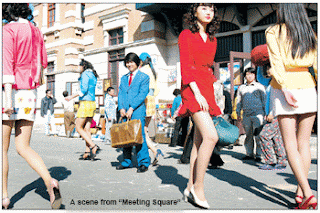 Helped by mere luck (or misfortune), he stumbles into a training program titled "Samcheong Gyoyukdae," which Young-tan wrongly takes for "Samcheong Education University." Samcheong Gyuyukdae, however, is not meant for teacher wannabes. It existed in the 1980s during the military dictatorship in Korea, and it was a notorious boot camp designed to punish dissenters.
Another lucky turn sends Young-tan to a village where he is mistaken for a teacher, while the real teacher (played by Ryu Seung-beom) is lost in woods packed with land mines.
From this point on, the film mixes comedy and semi-mystery, with villagers led by the town chief (Lim Hyeon-shik) acting weirdly. The puzzle, which is not hard to unravel for most Korean audiences, manages to get the plot rolling, with Young-tan falling in love with a beautiful yet bad-tempered girl Seon-mi (Park Jin-hee).
To Young-tan's dismay, the town chief and his sister-in-law Seon-mi seem to be having an affair, a classic comedy of misunderstanding that introduces a chain of unexpected events.
Many of the village scenes are reminiscent of "Welcome to Dongmakgol," and the villagers' innocent -- at least superficially -- behaviors are tailored for lighthearted comic scenes.
But the refreshing theme of the decades-long division on the Korean Peninsula is not a dominant factor in the film, largely because it is the main characters that shore up the drama. Lim Chang-jeong shows off his trademark dashing act to the full, while Lim Hyeon-shik showcases what only an experienced actor can do for the big screen.
Intermittently, the ill-fated real teacher played by Ryu Seung-beom injects real humor into the otherwise flat storyline. Ryu's performance is undoubtedly a showstopper here, with his gags getting funnier and funnier toward the end after he steps on a landmine and has to deal with the lethal crisis deep inside a forest in total isolation.
"Mannamui Gwangjang," produced by CY Film, is scheduled to be released nationwide on Aug. 15.
 Helped by mere luck (or misfortune), he stumbles into a training program titled "Samcheong Gyoyukdae," which Young-tan wrongly takes for "Samcheong Education University." Samcheong Gyuyukdae, however, is not meant for teacher wannabes. It existed in the 1980s during the military dictatorship in Korea, and it was a notorious boot camp designed to punish dissenters.
Another lucky turn sends Young-tan to a village where he is mistaken for a teacher, while the real teacher (played by Ryu Seung-beom) is lost in woods packed with land mines.
From this point on, the film mixes comedy and semi-mystery, with villagers led by the town chief (Lim Hyeon-shik) acting weirdly. The puzzle, which is not hard to unravel for most Korean audiences, manages to get the plot rolling, with Young-tan falling in love with a beautiful yet bad-tempered girl Seon-mi (Park Jin-hee).
To Young-tan's dismay, the town chief and his sister-in-law Seon-mi seem to be having an affair, a classic comedy of misunderstanding that introduces a chain of unexpected events.
Many of the village scenes are reminiscent of "Welcome to Dongmakgol," and the villagers' innocent -- at least superficially -- behaviors are tailored for lighthearted comic scenes.
But the refreshing theme of the decades-long division on the Korean Peninsula is not a dominant factor in the film, largely because it is the main characters that shore up the drama. Lim Chang-jeong shows off his trademark dashing act to the full, while Lim Hyeon-shik showcases what only an experienced actor can do for the big screen.
Intermittently, the ill-fated real teacher played by Ryu Seung-beom injects real humor into the otherwise flat storyline. Ryu's performance is undoubtedly a showstopper here, with his gags getting funnier and funnier toward the end after he steps on a landmine and has to deal with the lethal crisis deep inside a forest in total isolation.
"Mannamui Gwangjang," produced by CY Film, is scheduled to be released nationwide on Aug. 15.
Wednesday, August 8, 2007
Actress Oh Comes Back After 10 Years
.jpg)
Actress Oh Hyun-kyung, 37, who was shunned over a sex video scandal, will be back on television sets after a 10-year absence. Oh will appear in the drama ``The First Wives Club,’’ broadcasted by SBS to air Sep. 29.
During her long leave she has come to know, learn and experience much, the former Miss Korea told reporters at a press conference on Aug.7. Moreover, she now has a five-year old daughter and motherhood has given her the courage to press on.
For the actress, the ten years away from screens can be summed up in two words: pain and love. She was forced to quit acting after video footage of her having sex with her then boyfriend was distributed through the Internet, an incident that was almost unbearable for Oh at the time. ``What I experienced was something that was hard to bear at that age, my late-twenties. I felt like I was living in a separate world,’’ Yonhap News quoted Oh saying at the press conference.
There’s always a bright side to things, however, and for Oh, the scandal helped her to discover the love and care of people around her. Oh said that many people had helped and encouraged her to take up acting again, and it was these people who made her realize how lucky she is.
The beauty pageant winner showed determination to work hard to win hearts, vowing to approach viewers through her acting and her way of life, rather than with words.
Source : Korea Times
Tuesday, August 7, 2007
Zo to Appear in Epic Movie
.jpg) Korea's heartthrob Zo In-sung will join hands once again with director Yu Ha in an epic movie set during the Goryeo Kingdom (918-1392). The movie has yet to be titled, but will be produced by Opus Pictures and makes a fresh attempt at dealing with homosexual love. Zo and Yu last worked together in 2006 ‘’A Dirty Carnival”, which won Zo the lead male actor award at the 2006 Korea Film Awards.
Korea's heartthrob Zo In-sung will join hands once again with director Yu Ha in an epic movie set during the Goryeo Kingdom (918-1392). The movie has yet to be titled, but will be produced by Opus Pictures and makes a fresh attempt at dealing with homosexual love. Zo and Yu last worked together in 2006 ‘’A Dirty Carnival”, which won Zo the lead male actor award at the 2006 Korea Film Awards.In the movie, Zo will appear as a Goryeo warrior, balancing a romance between both a male and female counterpart, but Yu clearly stated the movie as ``a love story between men,’’ Yonhap News Agency reported. The scenario will be completed around the end of September, while other cast members have yet to be decided on.
Zo had many options for his last work before his compulsory military service, but his trust in Yu was the main reason he Zose to appear in the film without even knowing the exact details of the movie. Director Yu has been widely acclaimed by moviegoers and critics alike for bringing out violence and collectivity from deep within the human soul, as well as for his provocative view on conventional ideas. His movies include ‘’Crazy Marriage” in 2001, ‘’Spirit of Jeet Keun Do” in 2004 and ‘’A Dirty Carnival.”
Zo will train in martial arts beginning late August to make himself fit for the role of a warrior. As the setting is during the Goryeo period, he will not only learn horseback riding and fencing, but will also be taught to play the geomungo.
The epic movie will be a new attempt for Zo who is well known for his urban stylish looks.
Speaking of stylish looks, Levi’s announced Friday that they have Zosen Zo to model its Premium line starting mid-August because his sophisticated fashion style goes well with the line’s image.
Source : Korea Times
Monday, August 6, 2007
'The Houseguest' overstays its welcome
Chu Yo-sup (1902-1972) wrote the memorable short story "Saranbang sonmin-gwa eomeoni (The Guest in My Mom's House)." Published in 1935, the creative tale portrays the subtle emotional tension between a widow and a house guest from the perspective of a six-year-old girl. Emotions are intentionally suppressed, reflecting the strict social norms placed on Koreans at the time. 
Source : Korea Herald
"Sarangbang seonsuwa eomeoni (The Houseguest and My Mother)," directed by Im Yeong-seong, borrows the title from the famous short story, but does not follow the original plot. In contrast to Chu's refined storytelling, "The Houseguest" pursues a shamelessly trite Korean filmmaking format: Different cinematic elements are crammed onto the big screen not because they are essential but because the director wants to rescue a deplorable script.

In the film, Deok-gun (Jung Joon-ho) is 100 million won in debt to gangsters thanks to his irresponsible father who is now behind bars. Desperate to pay back the money, he takes on a peculiar assignment from an old lady, for a sizable fee, and drives down to a nondescript fishing town to track down her granddaughter. Deok-gun unpacks his luggage at a boarding house run by Hye-joo (Kim Won-hee), a single mom who lives with her bright yet rebellious teenage daughter Ok-hee (Ko Eun-ha). With his search getting nowhere, Deok-gun notices that Hye-joo has saved exactly 100 million won in her bank account, and hatches a woo-and-run scheme that gets the plot rolling.
The movie juxtaposes the shattered father-son relationships with the solid mother-daughter bond in a way that stresses the importance of being part of a family. But the movie fails to introduce meaningful details about Deok-gun's relationship with his father in the prison, nor does it offer any clues about why and how Hye-joo gave birth to Ok-hee at the age of 15.
Even though there are a growing number of single moms in Korea, it is rare to see a 15-year-old girl become a mother overnight. The movie does not -- intentionally or simply out of laziness -- provide convincing background stories that explain Hye-joo's difficult circumstances.
For most Korean moviegoers, the film's casting suggests that the selling point of "The Houseguest" is its comedy. After all, Jung Joon-ho (My Boss, My Hero) and Kim Won-hee (Marrying the Mafia 3) are the country's leading comic actors.
Unfortunately, the movie is not a pure comedy. In the first half of the film, numerous attempts are made to generate laughter, but most of the supposedly funny scenes are either overly simplistic or embarrassingly tacky.
For instance, as with other Korean comedy films, "The Houseguest" characters go to a noraebang, or karaoke, but their uninspired performances evoke sympathy rather than genuine laughter.
Sidekicks often use foul language for no apparent reason, along with exaggerated gestures that are hardly funny. Seong-chil (Im Hyeong-joon), who has a crush on the widow, mistreats his buddies in the village, again without generating any meaningful dramatic effect. Toilet humor, inserted for dubious reasons, is simply lamentable.
Toward the end of the film, the central characters encounter a melodramatic development intended to tug at the heartstrings of the audience, but the impact is minimal at best.
"The Houseguest" incorporates many of the old Korean filmmaking practices. Famous actors are recruited to increase its commercial odds at the box office but their acting does not exude genuinely creative energy. Nor does the hybrid genre -- a half-baked melodrama trapped in a comedy -- break any cinematic ground.
Perhaps it would have been much better if "The Houseguest" had faithfully reflected Chu Yo-sup's short story, where the guest does not overstay his welcome.
Source : Korea Herald
Actress Jeon Named Leading Lady of Entertainment
Actress Jeon Named Leading Lady of Entertainment
On the heels of her win as best actress at the 60th Cannes Film Festival in May, Jeon Do-yeon has been named among the 50 most influential women in the entertainment industry by U.S. magazine "Variety".
Among all the entertainment categories including film, TV, and publishing, only four actresses were selected - Jeon, Angelina Jolie, Helen Mirren and Marion Cotillard.

"Korean critics call Jeon a chameleon," Variety wrote. "At Cannes in May, when Alain Delon presented her with the best actress prize for Lee Chang-dong's 'Secret Sunshine' -- in which she played a woman devastated by the loss of her son -- it was Korea's first acting award at the world's premiere film showcase. It also was considered the one award outside of the Palme d'Or that set all heads nodding in agreement.'
On the heels of her win as best actress at the 60th Cannes Film Festival in May, Jeon Do-yeon has been named among the 50 most influential women in the entertainment industry by U.S. magazine "Variety".
Among all the entertainment categories including film, TV, and publishing, only four actresses were selected - Jeon, Angelina Jolie, Helen Mirren and Marion Cotillard.

"Korean critics call Jeon a chameleon," Variety wrote. "At Cannes in May, when Alain Delon presented her with the best actress prize for Lee Chang-dong's 'Secret Sunshine' -- in which she played a woman devastated by the loss of her son -- it was Korea's first acting award at the world's premiere film showcase. It also was considered the one award outside of the Palme d'Or that set all heads nodding in agreement.'
The magazine further hailed her, saying "When it comes to Asian acting talent, (Jeon and Cannes juror Maggie Cheung) have few equals."
Source : Chosun
Subscribe to:
Posts (Atom)