Thursday, August 30, 2007

Summit of the Starlets - Jessica Alba and Lee Hyo-lee

Korean cosmetics brand Isa Knox has unveiled the story to its much-anticipated commercial starring Lee Hyo-lee and Jessica Alba. The ad for the company's Double Effect Advanced Serum emphasizes the two starlets' sex appeal and embraces their unique charms.


Beneath the headline, "A woman's face is lies", a tearful Lee breaks up with a man while a smiling Alba does the same. Then, in the latter part of the ad, the situation is reversed and the copy tells us, "Now Lee Hyo-lee smiles" and "Jessica Alba weeps". The ad intends to suggest that women make no bones about telling a lie to finish with men. The company says the copy "A woman's face is lies" denotes that a woman's skin is lies, too.

The two stars were the center of attention during the filming of the commercial in Vancouver, where observers commented on their gorgeous and quite similar figures. The two resemble each other in stature, shape, hair style and even healthy-looking copper skin tone.

Their beauty managers took great pains to adorn the stars, who were competing for national pride. Their stylists each transported about 50 outfits to Canada, filling their hotel rooms with clothes like a boutique.

The commercial is slated to air next month.

Source : Chosen Ilbo

Wednesday, August 29, 2007

Doll-Like Actress Park Min-young Captures Viewers' Hearts


Up-and-coming actress Park Min-young has recently been the media's center of attention with her doll-like appearance on the popular television drama 'I Am Sam.'

Some of her photos on her personal website were taken on the set of 'I Am Sam.' Fans have been raving over her adorable appearance, describing the actress as a "living doll."

Viewers are also talking about the equally adorable hair and fashion styles she has been sporting on the drama.

In the drama, Park is a bubbly and trouble-making high school student who is also the only daughter of a gangster boss. Audacious and stubborn on the outside, she is actually a lovable and naive character who has captured the hearts of TV viewers.

Her cute school look in the drama has also caused a fashion sensation among younger generation fans.

Source : KBS Global

Upbeat spin on Korean men (The Happy Life)

For the family. For the company. For the future. There is almost always some excuse for not doing something that we really want to do. We proudly call it "sacrifice" that is necessary for our happiness. After all, our true wishes will be realized some day if we gladly persevere present suffering.

The only embarrassing truth is that such a dream-come-true, suffering-well-endured day never comes for working-class people who are often forced to confront one painful challenge after another.

"The Happy Life," directed by Lee Jun-ik ("King and the Clown" and "Radio Star") starts off to a slow start, toying with the idea of the sadness and loneliness that grip middle-aged Korean men beset by a variety of troubles at home and in the workplace.

Worse, Ki-young (Jung Jin-young) does not have a workplace to complain about. He's laid off from a financial company and has to get by on just 10 bucks a day, a meager allowance from his wife Sun-mi (Kim Ho-jeong). Even his teenage daughter Ju-hee, played by Ko Ah-seong ("The Host"), does not have much respect for his father, who has spent his prime years for the family. Powerless and money-less, Ki-young is shunned like a ghost. Aware of his awkward position in the family, he finds himself going outside when Ju-hee brings her school friends to his house.

Seong-wook (Kim Yoon-seok), a close friend of Ki-young's, is in no better position. He also lost his job recently. He has talented and intelligent kids and an education-obsessed wife to support, so he's working like hell -- a bike courier during the day and a paid driver for hire during the night.

The last member of the trio is Hyeok-su (Kim Sang-ho), a glib car salesman who works equally hard to foot the bill for the expensive schooling for his children who stay in Canada with his wife.

They went to the same college and -- yes, it's hard to believe -- they used to be a four-member rock band. They even joined the national college song competition as many as three times, only to face humiliating rejection at every attempt.

A turning point comes when long-forgotten band member, Sang-ho, suddenly dies, leaving his only son, Hyeon-jun (Chang Geun-seok). The three struggling middle-aged men, facing a personal crisis of their own, stumble into something that they have secretly missed for the past decades and yet have not had the courage to put into action -- a rock band.

Director Lee is particularly adept at weaving a web of small plot points that eventually form a bigger picture -- a rock band whose members represent average Korean men in their 40s who have very little to lose, even if they put a tattoo on their arms and put on outlandish outfits that are only encouraged in the upscale Hongdae club district in western Seoul.

The story itself is hardly an eye-opener; the real strength is hidden behind the seemingly straightforward plot. Director Lee does not put too many melodramatic flourishes on the three men and the young boy, but neither does he stay aloof from the heart-shattering incidents that put to a grueling test their friendship and adventurous, rebellious spirit that remains latent until recently.

The name of the band, aptly called "Active Volcano," is a venue where they transform their latent spirit into overflowing energy on the stage. Director Lee's tenacious camera tracks the amateur band's emotional performances up close and from a distance, striking a gentle balance in a way that prods the viewers to get in sync with the trouble-laden yet high-spirited band members.

Many of the key scenes involve the oft-cited negative aspects that snare middle-aged Korean men -- a set of obstacles that resonates more forcefully toward the end, with Hyeok-su considering shutting down his auto sales shop altogether and solving his family crisis.

In "The Happy Life," the real cinematic delight comes from the music itself, mostly retro and intermittently modified to the taste of clubbing youth. What is remarkable is that all the music pieces are actually performed by the actors -- no small feat considering that they are not professional musicians.

Although professional musicians may well find fault with every move of the band members from Ki-young's lead guitar to Seong-wook's bass to Heok-su's drum, director Lee does not allow such critical perspectives to step in because he steers the plot along an uninterrupted track full of renewed energy and not-so-latent vigor. Lee also sticks to the core message to the end: Sacrifice no more and do whatever you really want to do, however late it might be.

Source : Korea Herald

Tak Jae-hoon far from 'Worst Guy'


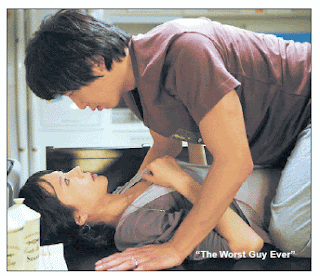
For three minutes, actress Yum Jung-ah heats up the screen of her new movie "The Worst Guy Ever," wearing leather and fishnet stockings while executing a purposefully amateurish pole dance. .

Yum said awkward sexy dancing wasn't an activity she was looking forward to. It took some prodding from costar Tak Jae-hoon to make her feel comfortable.

"It took five or six hours to shoot and the costume was strange. It wasn't a situation where I was supposed to execute a good, sexy dance, but (rather) it was intentionally bad. And so I was embarrassed throughout and the filming was a bit difficult," Yum said at last Thursday's preview of the movie. "But with Tak Jae-hoon's support, I was able to act without much persuasion."

Though one can hardly tell by Tak's negative reaction in the film, it wasn't the first time he'd seen this dance. It was actually a previous firsthand experience that inspired the comical dance. "When I was a newlywed, we danced a similar dance," Tak admitted. "I took that experience into account and suggested this idea."

The pole dance is just one of the sequences that contrast Joo-yeon (Yum Jang-ah) and Seung-tae (Tak Jae-hoon), who decide to tie the knot after finding themselves together in bed on two separate nights of drinking.

Friends for ten years, their first nights of newlywed life are enjoyable, but things quickly go sour and their marriage turns into a nightmare as they figure out they are completely incompatible.

Joo-yeon feeds her husband nothing but ramen noodles and preservative-saturated food -- when she feeds him at all -- while filling the house with ugly furniture that Seung-tae thinks should belong in an antique museum. Perhaps such sentiments echo in the actor himself as Tak was quick to point out what he saw was a mistake in the title.

"Right now, I seem to be holding the improper title of the 'Worst Guy Ever,' because in the movie, Yum Jung-ah comes across as the naughtier person, and so I asked on several occasions to change the title of the movie, but it never got done," Tak said.

Meanwhile Joo-yeon thinks it's Seung-tae who is the antique relic as he spends more time with his books than with his wife, and drives her crazy with incessant nagging.

To complicate matters, they each meet co-workers who seem to be their perfect matches and begin to have doubts about their marriage and their individual will.

"I am married. I am married," is a line Joo-yeon repeats to herself as she finds herself swooning over a new co-worker, Jae-hoon (Shin Sung-rok).

Seung-tae's predicament is similar as his career-oriented boss Mi-yun (Yoon Ji-min) is touched by his awkward kindness and goes on the offensive, ignoring him as he shouts reminders of his marriage.

From being locked together in a wardrobe to engaging in a heated kiss, the extramarital relationships grow in intensity and the situations compound themselves until everything becomes a tangled mess. Eventually, every relationship falls apart and nobody is left the better.

What does come through in the midst of this chaos is a shining starring debut role for Tak, who was charged with the responsibility of taking center stage. Though Tak has been in the Korean entertainment scene for over a decade, this movie marks his first major breakaway from singing and television appearances.

"When I was offered the role, Yum Jung-ah was already cast," Tak said. "I felt a bit of a burden because she is such a good actor with plenty of experience and is a veteran in the field."

But in the movie, the two stand as equals, matching each other punch for punch.

"The first starring role has special significance to anyone. Beyond giving my full effort to the mere filming, I tried to draw upon my experiences and thoughts to enhance the film as a romantic comedy," Tak said. "I collaborated with the director (Son Hyun-hee) often, and it led to ideas like the pole dance scene and (Yoon's) yoga scene."

While Tak holds his own among the cast, and even took a leading role in the development of the film, powerful cameo appearances often steal the spotlight from the regular cast. But they are also of the strengths of the movie, bringing explosive laughter into the theater just when the comedy seems to come to a lull.

A cameo from Shin Hyun-joon, with whom Tak forged a tie on the set of the movie "Barefoot Gi Bong," delivers a hilarious performance as a flippant and perhaps mentally abnormal employee at the divorce registration center.

Even Tak, who arranged most of the cameos, recognized the power and presence the short appearances had on the film.

"It was nothing but fun when we were shooting the cameos, and I didn't think they would change the mood of the film as much as they did. If I had known this was going to happen, I don't think I would've used the cameo appearances," Tak joked.

Comedian Kim Mi-ryeo delivers another stellar cameo performance as a sister-in-law who can't hide her contempt for Joo-yeon, especially when she starts to take a friendly card game too seriously.

Several other cameos seem to emphasize the comedic dimension of the movie. Though classified as a romantic comedy, the movie in itself is short on romance and heavy on the comedy. The drama is difficult to believe -- seriously, what man would react to their wife's private pole dance by going to sleep? -- and some of the decisions made by the characters cannot be explained, even by the cast members themselves.

"I couldn't understand how Jae-hoon could let Joo-yeon go so easily if he felt for her in such a way that he was willing to destroy a marriage and a family," Shin said, referring to one of the last sequences of the movie.

If a believable romance movie is what you're looking for, "The Worst Man Ever" will fall short of expectations, but in the realm of non-stop laughter, the film delivers for the full 94 minutes.

Source : Korea Herald

The 12th Pusan International Film Festival announces its Opening and Closing Films

August 29, 2007 (Busan, Korea) - The 12th Pusan International Film Festival announced today its opening and closing films. The festival will open with FENG Xiaogang’s Assembly (China), and close with Evangelion 1.0: You Are (Not) Alone (Japan), a Japanimation by Hideaki ANNO, Kazuya TSURUMAKI, and Masayuki.
The much-anticipated Assembly world premieres at PIFF as the opening film. It is the newest film of FENG Xiaogang who gained nation-wide fame in China after making such films as The Banquet, A World Without Thieves, and A Sigh. Co-produced by China’s Huayi Brothers Media & Co. Ltd. and Korea’s MK Pictures, this film is more than a war-epic; it is a human drama of a soldier who devotes his entire life to redeeming the honor of his fellow soldiers who are declared missing in action. The battle scenes were perfected by the special effects team of 2004’s Korean hit, Taegukgi (English title: The Brotherhood of War).
The closing film, Evangelion 1.0: You Are (Not) Alone (working title) is the theater adaptation of the 1995 TV animation series, Neon Genesis Evangelion that created die-hard mania and enjoys popularity even till today. In 1997, Neon Genesis Evangelion went to the big screen to see unprecedented box-office success, and this year, 10 years after Evangelion’s first theatrical release, the title is re-born with totally new ending and new interpretation. Evangelion 1.0: You Are (Not) Alone - the first episode out of the trilogy- will be revealed in Japan on September 1st, 2007 and will international premiere at PIFF.


Opening Film - Assembly
FENG Xiaogang
Feng is an actor, director, and writer. He began his career in cinema working as an art designer in Beijing Television Art Center in 1985. Later, he moved on to writing screenplays working closely with director Zheng Xialong and writer Wang Shuo. He achieved his fame as director of Dream Factory (1997) which was a mega hit in China and established a genre called “Hesui Pian” (New Year Films). It is also interesting to note that almost all of Feng’s films star Ge You in a major role.


Closing Film - Evangelion 1.0: You Are (Not) Alone
Hideaki ANNO
Born in 1960, Anno started making feature films and animations when he entered university. Upon graduation, he worked on Nausicaa of the Valley of the Wind (1984) directed by Hayao MIYAZAKI. In 1995, he directed the TV animation Neon Genesis Evangelion the last 2 episodes of which were theatrically released. Anno has also directed many other films, including Cutie Honey (2004).

Masayuki
Born in 1961, Nagano Prefecture. He worked as an Animation Director/ Key Animation Supervisor for Nadia of the Mysterious Seas (1990). He recently worked for Hideaki Anno’s feature titles.

Kazuya TSURUMAKI
Born in 1966, Niigata Prefecture. He worked for Neon Genesis Evangelion as a Second Director, and for the theatrical title of the series Evangelion: Death & Rebirth. He co-directed the title with Anno and Masayuki.

Source : PIFF

Monday, August 27, 2007

'In Between Days' and 'Let's Not Cry!' show visual audacity

"In Between Days" and "Let's Not Cry!" share striking similarities: Korean directors, exotic (at least in the eyes of Korean audiences) locations, and refined experimental spirits which earned the filmmakers awards at international film festivals.

"In Between Days," a debut feature by Kim So-yong, a Korean American multimedia artist, delves into the life of a Korean immigrant who has to deal with not only the strangeness of adapting to a new culture but also a sense of loneliness that deepens along with her faltering relationship with a boy she has a crush on.

This Sundance and Berlin prize-winner, to be released nationwide on Sept. 6, literally zooms in on Aimie (Kim Ji-seon), a teenage girl who recently arrived in a North American city. But she finds it hard to find a comfortable place. She's already bored with her school, thanks largely to her poor English, and even the small apartment where she lives with her divorced mother looks dreary as the depressing winter cityscape the film features intermittently.

Aimie tries to secure some emotional relief from her handsome but gangly friend Tran (Kang Tae-gu), but their relationships never go forward as she wishes. She wants genuinely romantic gestures from Tran, given that they spend much time loafing around together, but Tran does not seem to have any intention to turn their "best friend" relationships into something else.

Director Kim's tenacious camera relies on extreme close-up framing to capture the subtle change in Aimie's emotions -- from expectations to frustration to disappointment -- in a style that brings more authentic realism than any other Korean initiation film.

The film's virtue lies in its self-restraint in portraying Aimie's adolescent travails that get complicated with her immigration experience. Aimie is utterly unable to handle the difficulty of establishing new relations, even with other Koreans living in the same quarters, but director Kim does not fall into a melodrama rut; instead, she keeps her camera closer to Aimie, tracking her subtle facial expressions that tell volumes about her emotions, angst and uncertainty.

All of this is thankfully cliche-free. Director Kim's unique hyper-realistic cinematography also helps evoke plenty of sympathy with Aimie's confused state that is delicately accentuated by the wintry background, leaving a glimmer of hope for the lonely girl when the spring comes.

In "Let's Not Cry," second feature by Min Boung-hun, the protagonist Muhamad is similarly in a lonely state, but unlike Aimie he has only himself to blame for his hopeless predicament.

The film, which has won awards at Karlovy Vary and Thessaloniki film festivals, is set in the ex-Soviet satellite state of Uzbekistan, depicting Muhamad's struggle to survive through an endless stream of lies. This talkative man never stops shaking hands with people and dispensing friendly gestures.

The trouble is that Muhamad is actually on the run after running up a huge amount of debt at a casino, though the unsuspecting villagers in his hometown initially assume he's a successful violinist in Moscow.

When confronted about his true conditions, Muhamad never flinches. Instead, he keeps his voice up and talks fast in an apparent bid to steer the conversation in his favor.

But his usual trick does not work on his hard-working mother who leads a painful life in a shabby house with her teenage son. Noticing something fishy about Muhamad's sudden return, she secretly checks his son's violin case and finds out that he is not what he claims to be.

Muhamad, however, keeps bragging about his celebrated life in Moscow as a leading musician who frequently goes abroad for staging performances. His mother asks Muhamad to stay in the hometown and live with the family, a kind offer that is flatly rejected by Muhamad who is broke and yet adamantly unwilling to live in the thrall of poverty in a remote, scarcely populated village.

Muhamad seeks a breakthrough in cheating a fortune out of his grandfather who digs up rocks and breaks them into smaller pieces, and build rock formations, a toil that seems to bring no financial reward at all.

Well versed in worldly pursuits, Muhamad cannot understand why his grandfather is wasting his time and energy away, working his way through debris of rocks at a deserted gold mine in the mountains. Nor can he understand why all of his friends flatly reject his distress calls for money.

In the meantime, a wealthy and bossy man in the town is preparing a big wedding party for his son, and asks Muhamad to play some music at the party. Unfortunately, he has no time to join the festivity because he has to leave soon, with police tracking down on him in connection with the debt-and-run.

For all the personal weaknesses, Muhamad is hardly a wicked character. He is rather a figure who can easily draw some sympathy. He, after all, asks his younger brother to refrain from telling a lie in a preachy tone. He also knows how to reciprocate a gesture of kindness (or affection) properly, even if things exchanged involve just cheap accessories and eggs.

Made in 2001, "Let's Not Cry!" is finally set to be screened at a local theater in Seoul from Aug. 30 and yet its cinematic audacity is more striking and powerful than ever.

Source : Korea Herald

Sunday, August 26, 2007

Son Ye Jin, returns to the screen in two years as a femme fatal pickpocket

Top star Son Ye Jin will turn into an 'international' pickpocket.

In the upcoming movie 'Open City' directed by Lee Sang Ki, Son Ye Jin will act as the boss of a pickpocket organization displaying her femme fatal charm.

Scheduled to open in December, she is appearing on screen two years after the movie 'The Art of Seduction' which opened in 2005.

The movie has especially gathered attention as she will be partnering with actor Kim Myung Min of the MBC drama series 'White Tower.'

'Open City' which depicts the conflict between an international pickpocket organization and an investigation team will feature Son Ye Jin who rids of her innocent image in a seductive and strong character.

Her character Baek Jang Mi grows her organization with her charm femme fatal charm, making any man want to give up everything to be with her.

But falling in love with Kim Myung Min, a member of the investigating team, she cannot hide her identity as a female and her painful past.

Son Ye Jin is currently training for the action scenes in the movie that will crank in at the end of this month.

Source : Broasia